
Mis à jour le 17 juillet 2026 — actualisé avec des données vérifiées de la plateforme sur le nombre d'apps générées par IA qui reçoivent réellement de vrais backends.
Comment VULK génère-t-il un backend automatiquement ?
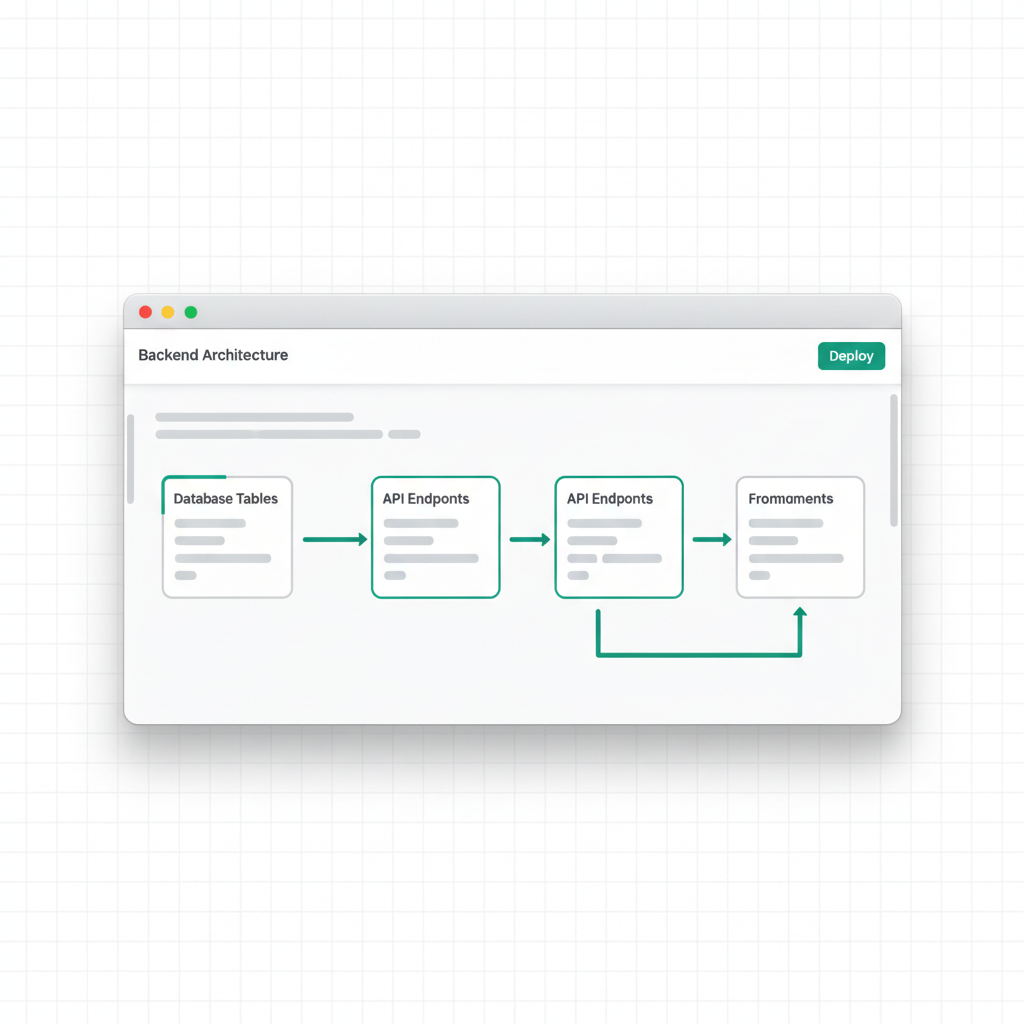
La réponse complète : VULK lit ton prompt à la recherche de signaux backend — comptes, données sauvegardées, panneaux d'administration, APIs — et quand il les trouve, il génère une application côté serveur complète aux côtés de ton frontend : un schéma de base de données relationnelle (tables, clés étrangères, index, contraintes), des endpoints CRUD RESTful pour chaque entité, une authentification basée sur JWT avec hachage bcrypt des mots de passe, et un frontend déjà raccordé à ces endpoints avec tokens, états de chargement et gestion des erreurs. Pas de compte Supabase, pas de projet Firebase, pas de configuration externe — le backend se déploie sur l'infrastructure de VULK avec ton app (plan Builder et supérieurs).
C'est important parce que « les builders d'apps IA font des jouets d'UI » est désormais un mythe, et les données le prouvent : 62 % de toutes les apps générées sur VULK incluent un schéma SQL de base de données, et 27 % reçoivent un backend provisionné — une API vivante plus une base de données hébergée. SQL est le type de fichier n°3 le plus généré sur la plateforme, avec 6,1 % de 124 755 fichiers, derrière seulement TypeScript et JSON (données de la plateforme VULK, juillet 2026, N = 11 355 projets). La plupart des apps « vibe-codées » sont des applications de données, pas des pages statiques.
Qu'est-ce qui cloche chez les builders IA frontend-only ?
La plupart des générateurs de code IA te donnent une app React avec des données codées en dur. Le formulaire de login est joli mais n'authentifie personne. Le dashboard montre des graphiques avec du JSON statique qui ne change jamais. Le bouton « Enregistrer » déclenche une notification toast mais n'enregistre rien.
J'ai construit la génération de backend de VULK parce que j'en avais assez de voir ce schéma. Un frontend sans backend est un prototype, pas une application. Et si tu paies pour un builder de code IA, tu devrais obtenir quelque chose qui fonctionne vraiment.
Quand ton prompt décrit une fonctionnalité qui exige un backend — comptes utilisateur, données sauvegardées, endpoints d'API, panneaux d'administration — VULK génère le backend automatiquement. Pas un mock. Un vrai backend avec base de données relationnelle, routes d'API, authentification et migrations de schéma. Le formulaire de login te connecte vraiment. Les données persistent vraiment. Les endpoints d'API répondent vraiment.
Comment fonctionne la détection de backend ?
Tu n'as pas besoin de dire « génère un backend ». Tu décris ce que tu veux, et VULK détermine si un backend est nécessaire d'après les signaux de ton prompt.
| Type de signal | Mots déclencheurs | Ce que cela active |
|---|---|---|
| Authentification | « login », « inscription », « comptes utilisateur », « panneau d'administration », « rôles et permissions » | Système d'auth : endpoints d'inscription/connexion, middleware JWT, routes protégées |
| Persistance de données | « enregistrer », « stocker », « base de données », « CRUD », « enregistrements », « historique » | Schéma de base de données + génération d'API CRUD |
| API | « API », « endpoint », « webhook », « REST », « récupérer depuis le serveur » | Génération de routes, même sans mention explicite de base de données |
La détection est volontairement précise : VULK ajoute un backend quand l'app stocke des données, a des comptes utilisateurs ou expose une API. La répartition sur toute la plateforme le reflète : 62 % des apps reçoivent un schéma, tandis que les portfolios, landing pages et jeux sont livrés comme des builds frontend légers (données de la plateforme VULK, juillet 2026).
Pourquoi PostgreSQL et pas Supabase, Firebase ou MongoDB ?
On me pose souvent la question, et je veux être transparent sur le raisonnement.
Pourquoi pas Supabase ou Firebase ? Parce que ce sont des services tiers qui créent des dépendances externes. Si je générais du code qui exige un projet Supabase, tu devrais créer un compte Supabase, monter un projet, configurer des variables d'environnement et gérer un service de plus. Cela casse l'expérience « un prompt, une app qui marche ». Le backend de VULK tourne sur notre infrastructure avec zéro configuration externe. (Si tu veux ton propre Supabase, cela existe en intégration opt-in sur Pro+ — tu connectes tes clés et l'agent travaille sur ton vrai projet. Ce n'est simplement jamais imposé.)
Pourquoi pas MongoDB ? Parce que la plupart des applications que les utilisateurs de VULK construisent sont relationnelles. Les tâches appartiennent à des projets. Les projets appartiennent à des utilisateurs. Les commandes contiennent des articles. Les produits ont des catégories. Ces relations s'expriment naturellement en tables avec clés étrangères, pas en collections de documents. MongoDB est excellent pour des cas d'usage précis, mais pour l'étendue des applications que VULK génère, les bases relationnelles produisent un code plus propre et plus maintenable.
Pourquoi PostgreSQL précisément ? C'est la base de données relationnelle open-source la plus capable. Conformité ACID complète, excellent support JSON quand il faut de la flexibilité, indexation robuste et un écosystème massif. C'est ce que je choisirais pour une application de production, donc c'est ce que VULK génère.
Que génère-t-il exactement ?
Quand la génération de backend se déclenche, VULK produit une application côté serveur complète aux côtés de ton frontend. Voici ce que comprend chaque couche.
Schéma de base de données. Des tables SQL complètes avec colonnes, types, contraintes, index et relations. Une table users reçoit id, email, password_hash, name, created_at et updated_at. Les posts reçoivent une clé étrangère vers les utilisateurs. Chaque table reçoit une clé primaire, des timestamps et des index sur les colonnes utilisées dans les requêtes.
La colonne s'appelle password_hash — jamais password. C'est une décision de sécurité délibérée que j'impose dans l'ingénierie du prompt. Les mots de passe sont hachés avec bcrypt à l'inscription et comparés à la connexion. Le nom de la colonne lui-même rend l'intention sans ambiguïté.
Endpoints d'API. Des routes RESTful pour chaque entité de ton schéma. Une table posts génère GET /api/posts (liste avec pagination), GET /api/posts/:id (enregistrement unique), POST /api/posts (création), PUT /api/posts/:id (mise à jour) et DELETE /api/posts/:id (suppression). Chaque endpoint inclut la validation des entrées, la gestion des erreurs et les codes de statut HTTP appropriés.
Système d'authentification. Inscription (POST /api/auth/register) et connexion (POST /api/auth/login). L'inscription hache le mot de passe avec bcrypt et le stocke. La connexion compare avec le hash et renvoie un JWT. Les routes protégées vérifient le JWT via middleware.
Intégration frontend. C'est la partie qui donne le sentiment d'un tout complet. Le frontend React est généré avec les appels API déjà raccordés. Les fetch pointent vers les bons endpoints. Les tokens d'auth sont stockés et joints aux requêtes. États de chargement et gestion d'erreurs inclus. Le formulaire de login authentifie vraiment. Le formulaire d'inscription crée vraiment un compte. Les données sauvegardées persistent vraiment entre les sessions.
À quoi ressemblent de vraies générations de backend ?
App de gestion de tâches : « Construis une app de gestion de tâches où les utilisateurs peuvent créer un compte, se connecter, créer des projets et ajouter des tâches aux projets. Les tâches ont un titre, une description, une priorité, une échéance et un statut. Les utilisateurs ne voient que leurs propres projets. »
Cela génère : table users, table projects avec clé étrangère user_id, table tasks avec clé étrangère project_id, endpoints d'auth, CRUD pour projets et tâches, middleware d'autorisation qui filtre par user_id.
Boutique e-commerce : « Crée une boutique en ligne pour vendre de la céramique artisanale. L'admin peut ajouter des produits. Les clients peuvent parcourir, ajouter au panier et passer commande. L'historique des commandes est sauvegardé dans le compte utilisateur. »
Cela génère : table users avec colonne role, table products, table orders, table de jonction order_items, contrôle d'accès basé sur les rôles, endpoints réservés à l'admin pour la gestion des produits, endpoints clients pour parcourir et commander.
Ces deux exemples ne sont pas des exotismes triés sur le volet — les dashboards/panneaux d'administration (12,5 %), l'e-commerce (4,5 %) et les systèmes de réservation (3,4 %) sont les principales catégories en forme de backend que les gens génèrent réellement (données de la plateforme VULK, juillet 2026).
Quelle est la qualité du schéma de base de données généré ?
Je tiens à la qualité du schéma parce que les mauvais schémas créent de mauvaises applications. Voici ce que VULK impose :
Les clés primaires utilisent des entiers auto-incrémentés pour la simplicité. UUID est disponible pour des cas d'usage précis.
Les clés étrangères incluent ON DELETE CASCADE quand c'est approprié (supprimer un utilisateur supprime ses posts) et ON DELETE SET NULL quand les enregistrements orphelins doivent survivre (supprimer une catégorie ne supprime pas les produits).
Les index sont créés sur les colonnes de clés étrangères, les colonnes email (pour les recherches de connexion) et toute colonne utilisée dans des clauses WHERE ou ORDER BY. Ce n'est pas une réflexion après coup — les index générés correspondent aux requêtes générées.
Les timestamps (created_at, updated_at) sont sur chaque table.
Les enums et contraintes sont utilisés pour les valeurs bornées. Le statut d'une tâche est contraint à des valeurs précises, pas à des chaînes arbitraires.
Quels patterns de sécurité sont intégrés ?
Voici ce que la plupart des gens ratent avec le code généré : ils le livrent sans penser à la sécurité. La génération de backend de VULK inclut des patterns de sécurité par défaut, parce que livrer sans eux crée de vraies vulnérabilités :
- Hachage des mots de passe avec bcrypt (jamais en clair)
- Requêtes paramétrées (jamais de concaténation de chaînes en SQL)
- Middleware de vérification JWT sur les routes protégées
- Validation des entrées sur tous les endpoints (vérification des types, champs obligatoires, limites de longueur)
- Configuration CORS limitant les origines au domaine du frontend
- Rate limiting sur les endpoints d'auth pour prévenir la force brute
- Requêtes scopées par utilisateur garantissant que chacun n'accède qu'à ses propres données
Ce ne sont pas des options à activer. Elles font partie de la sortie par défaut, parce que je crois qu'un code généré doit être sécurisé par défaut.
Quand la génération automatique de backend est-elle le bon choix ?
Elle fonctionne le mieux pour les applications standard orientées données : gestionnaires de tâches, outils CRM, systèmes d'inventaire, blogs, boutiques e-commerce, plateformes de réservation, dashboards. Elles suivent des patterns que les modèles d'IA maîtrisent bien, et le code généré est propre, lisible et maintenable.
Chaque fichier généré est lisible et modifiable. Pas de runtime propriétaire caché, pas de lock-in de framework sur le code que tu écris. Si tu dépasses le backend généré, tu exportes la source et la refactores comme n'importe quelle autre application.
C'est le principe autour duquel je construis : VULK doit accélérer ton développement, pas t'enfermer dans un jardin clos.
FAQ
Dois-je configurer quelque chose pour que le backend fonctionne ?
Non. La détection, la génération du schéma, le déploiement de l'API et le raccordement du frontend sont automatiques. Il n'y a pas de variables d'environnement à définir, pas de comptes tiers à créer, pas de dashboard à configurer avant que ton formulaire de login fonctionne. Le déploiement backend + base de données est inclus à partir du plan Builder (19,99 $/mois).
Puis-je voir et exporter les données de ma base ?
Oui. Le panneau Backend de l'éditeur inclut un navigateur de tables, un exécuteur de requêtes SQL et un export CSV par table (la table complète, pas seulement la page visible). Le schema.sql est aussi livré dans l'export ZIP de la source.
Puis-je connecter mon propre Supabase ou un backend externe à la place ?
Oui, en intégration opt-in sur les plans Pro et supérieurs : ajoute tes clés dans Settings → Integrations et l'agent lit et écrit sur ton vrai projet Supabase. Par défaut, cependant, les apps générées utilisent le backend intégré de VULK pour qu'un prompt donne une app fonctionnelle avec zéro configuration externe.
Que se passe-t-il si j'exporte le code — le backend vient-il avec ?
L'export du frontend est entièrement portable (Vite + React + TypeScript standard qui tourne partout). L'API backend et la base de données hébergée continuent de tourner sur l'infrastructure de VULK ; la source exportée les appelle en HTTPS.
Combien d'apps générées par IA utilisent réellement un backend ?
Sur VULK : 62 % des apps incluent un schéma SQL, 27 % font tourner un backend provisionné (API vivante + base hébergée), et SQL est le langage n°3 le plus généré avec 6,1 % de tous les fichiers (données de la plateforme VULK, juillet 2026). L'ère des « apps IA jouets statiques » est terminée.
L'authentification est-elle de niveau production ?
L'auth générée utilise le hachage bcrypt des mots de passe (dans une colonne password_hash), des sessions JWT, un middleware de vérification sur les routes protégées et du rate limiting sur les endpoints d'auth. Pour la plupart des apps, c'est une base de production solide ; ajoute la 2FA ou le SSO par itération si ton produit en a besoin.
Commence à construire sur vulk.dev.