Introduction
Not all AI models are interchangeable. A model that excels at generating complex business logic may produce mediocre visual layouts. A model optimized for speed may cut corners on code quality. A model with strong design sensibility may struggle with database schema design. The ability to choose between multiple models for different tasks is not a luxury -- it is a practical necessity.
Understanding the strengths and trade-offs of different model families helps you make informed choices that directly impact the quality of your generated applications.
How Models Differ
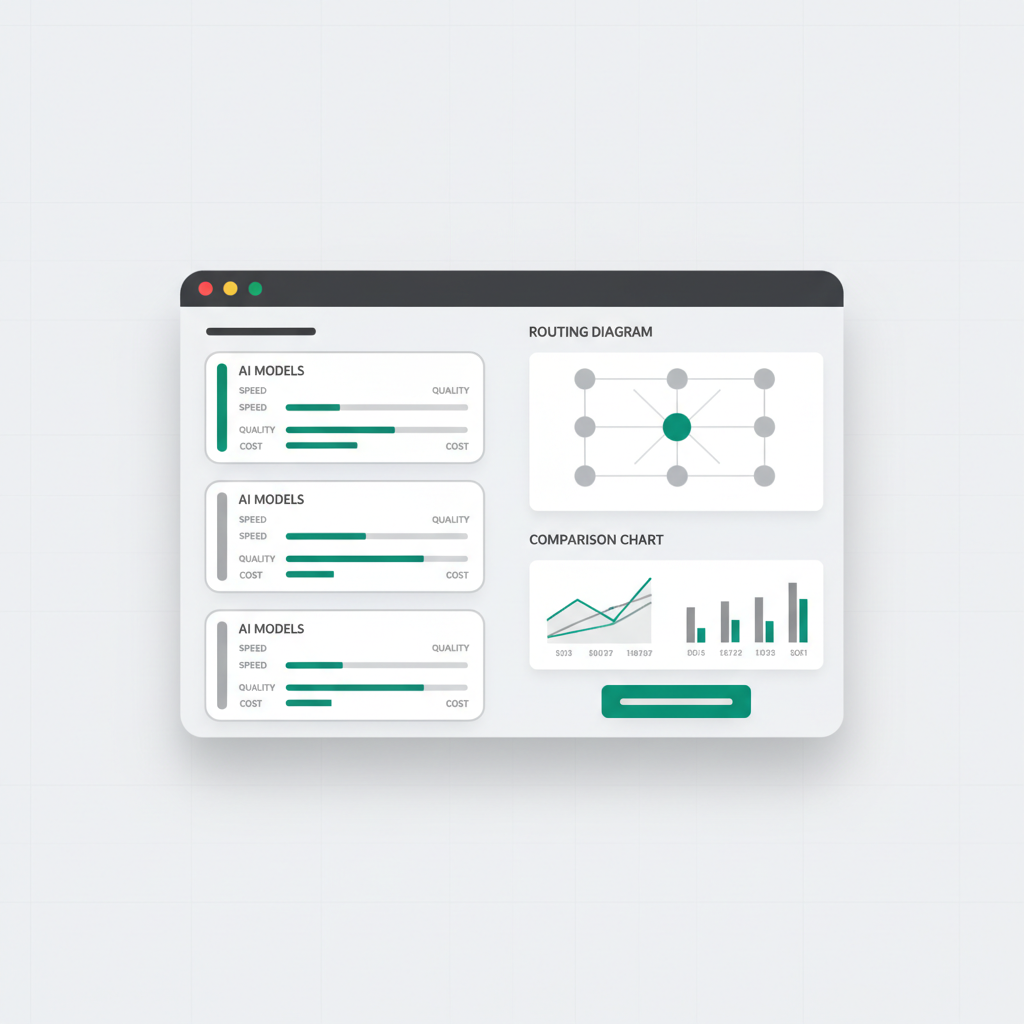
AI models differ along several dimensions that matter for code generation: reasoning depth, context window size, code quality, design sensibility, and generation speed. These properties are not independent -- models that reason more deeply tend to be slower, and models optimized for speed often produce simpler output.
Frontier models from labs like Anthropic (Claude), OpenAI (GPT-4), and Google (Gemini) represent the highest capability tier. They handle complex multi-file applications, intricate data relationships, and nuanced design requirements well. But they cost more per generation and take longer to produce output.
Mid-tier and open-source models generate faster and cost less. They handle standard patterns (dashboards, CRUD interfaces, landing pages) competently but may struggle with complex business logic, unusual layouts, or multi-step architectural decisions.
Matching Models to Tasks
The most effective strategy is matching the model to the task at hand rather than using the same model for everything.
For exploration and brainstorming, use a fast model. When you are experimenting with different approaches, trying several prompt variations, or generating throwaway prototypes, speed matters more than perfection. A fast model that generates a reasonable starting point in 15 seconds is more useful than a frontier model that takes 90 seconds to produce a slightly better result.
For production applications, use a frontier model. When the generated code will be deployed, shared with stakeholders, or used as the foundation for further development, quality matters. Larger models produce better component architecture, more thoughtful design decisions, and more robust error handling.
For design-heavy projects, choose models known for visual quality. Some models consistently produce more polished layouts, better color choices, and more thoughtful spacing. If your project is primarily a marketing site or portfolio, the model's design sensibility matters more than its reasoning depth.
For complex backends, choose models with strong reasoning. Database schema design, API architecture, and business logic implementation benefit from models that can reason about relationships, constraints, and edge cases. Simpler models may produce schemas that work for basic use cases but fail under real-world complexity.
Cost Considerations
Model pricing varies significantly. A complex application generated with a frontier model might cost $0.50-$2.00 in API credits, while the same application with a mid-tier model might cost $0.05-$0.20. For a single generation this difference is negligible, but for teams generating dozens of applications per day, model selection has a real impact on costs.
The optimal strategy is not always "cheapest model that works." A slightly more expensive model that produces better output on the first attempt saves money compared to a cheaper model that requires multiple rounds of editing. Factor in the time cost of iteration, not just the per-generation cost.
The Model Landscape in 2026
The AI model landscape evolves rapidly. Models that were state-of-the-art six months ago may be outperformed by newer releases. Platforms that support multiple models give you the flexibility to adopt improvements as they become available, rather than being locked to a single provider's trajectory.
Open-source models have improved dramatically and are competitive with proprietary models for many standard tasks. For organizations with data privacy requirements, open-source models that can run on private infrastructure offer an important alternative.

Practical Guidelines
- Start new projects with a fast model to explore the concept quickly
- Switch to a frontier model for the final, production-quality generation
- Use the same model for iterative edits to maintain consistency
- Compare outputs from different models when starting a new project type
- Stay current with new model releases -- the best choice changes over time
- Consider the total cost (generation + editing time), not just the per-generation cost
Conclusion
Multi-model access is a practical advantage, not a marketing feature. Different tasks genuinely benefit from different models, and the ability to choose gives you control over the quality, speed, and cost of your development workflow.
The best builders develop an intuition for which model to use when, just as experienced carpenters know which tool to reach for. This skill -- model selection -- is becoming as important as prompt writing in the AI development toolkit.
Published by João Castro · 6 min read