Best Practices for AI-Generated Code Quality
AI-generated code is only as good as the review process that follows it. This guide covers practical strategies for evaluating, improving, and maintaining the quality of code produced by AI generators.
Introduction
AI code generators can produce impressive results, but treating their output as production-ready without review is a mistake. Like code written by a junior developer, AI-generated code needs evaluation, testing, and sometimes refactoring before it meets production standards. The difference is that AI can produce the initial draft much faster, giving you more time for the review and refinement that actually determines code quality.
Understanding what to look for -- and what AI tends to get wrong -- makes you a more effective builder regardless of whether you write code manually or use generation tools.
Review the Component Structure
AI generators typically produce well-structured components, but they sometimes create overly large components that should be broken into smaller pieces. A single component handling navigation, data fetching, state management, and rendering is a red flag. Good component architecture separates concerns: a container component handles data, a presentation component handles display, and shared logic lives in custom hooks.
Check that components have clear, single responsibilities. A UserTable component should display user data in a table. It should not also handle user creation, deletion, and search in the same file. If you see components exceeding 200 lines, consider whether they should be decomposed.
Check TypeScript Types
One of the most common quality issues in AI-generated code is incomplete or overly permissive typing. Look for any types, which defeat the purpose of TypeScript. Check that API response types match the actual data shape. Verify that function parameters and return types are explicitly defined rather than relying on type inference alone.
Well-typed code catches errors at compile time instead of runtime. If the generated code uses any extensively, take the time to define proper interfaces. This investment pays off immediately in fewer runtime errors and better IDE support.
Evaluate Error Handling
AI-generated code sometimes takes the "happy path" approach -- it handles the success case well but neglects error scenarios. Check that API calls include error handling. Verify that user-facing components show appropriate error states (not just blank screens when data fails to load). Ensure that form validation provides clear, specific error messages.
For backend code, check that database queries handle connection failures, that input validation rejects malformed data before it reaches the database, and that error responses include appropriate HTTP status codes rather than returning 200 for everything.
Test Responsive Behavior
Generated applications are usually responsive, but edge cases can slip through. Test the application at common breakpoints: desktop (1440px and above), tablet (768px-1024px), and mobile (375px-414px). Look for overlapping elements, text truncation, and navigation patterns that work on desktop but break on mobile.
Pay special attention to data tables, which are notoriously difficult to make responsive. A desktop table with six columns needs a different presentation on a 375px-wide phone screen. Horizontal scrolling, card-based layouts, or column hiding are all valid solutions, but the generated code may not always implement them correctly.
Assess Accessibility
Accessibility issues are among the most commonly overlooked quality problems in generated code. Check that images have alt text, that form inputs have associated labels, that interactive elements are keyboard-navigable, and that color contrast meets WCAG 2.1 AA standards (4.5:1 for normal text, 3:1 for large text).
Screen reader compatibility, focus management in modals and drawers, and proper heading hierarchy (h1 through h6 in logical order) are areas where AI-generated code sometimes needs manual improvement.
Quality Checklist
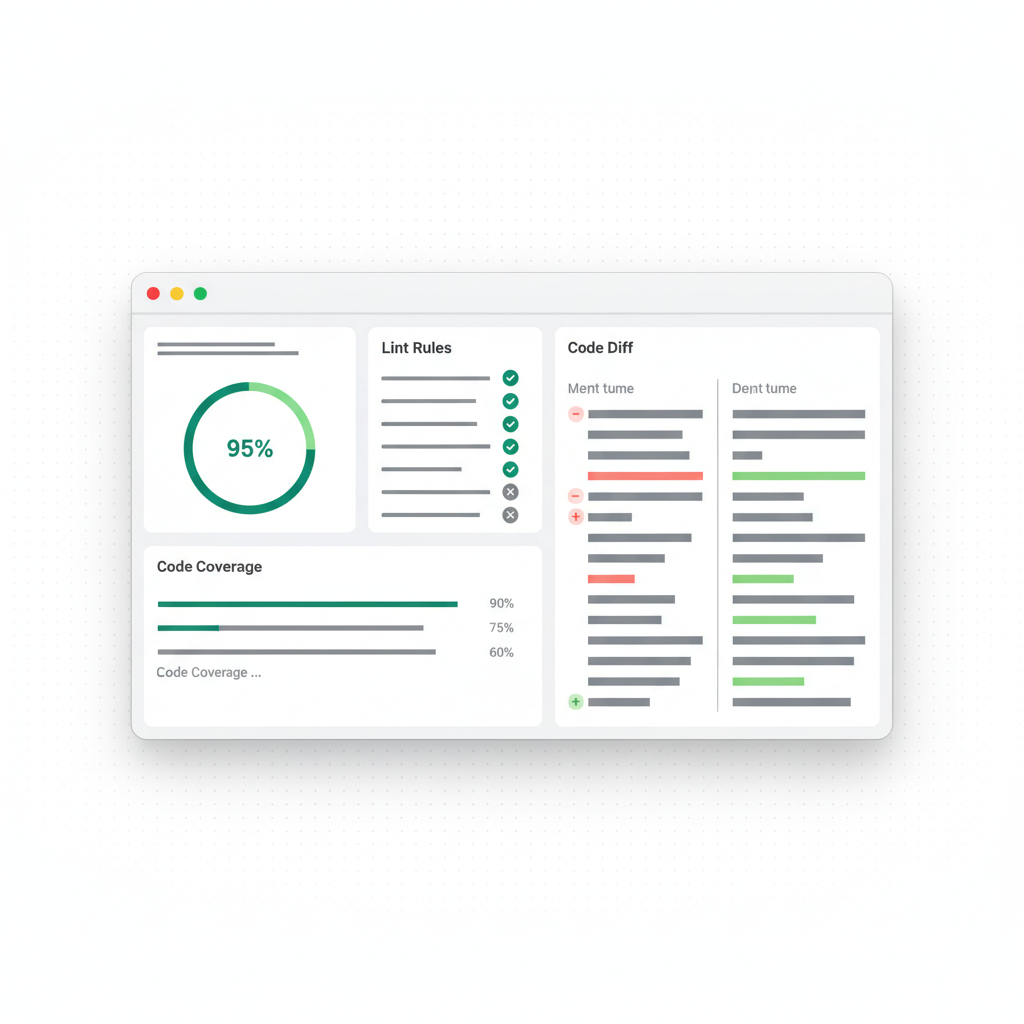
- Components follow single responsibility principle
- TypeScript types are explicit and avoid
any - API calls include error handling and loading states
- Responsive behavior works at all common breakpoints
- Accessibility basics are covered (alt text, labels, keyboard navigation)
- Database queries use parameterized statements (no SQL injection risk)
- Sensitive data is not exposed in client-side code
Conclusion
AI-generated code quality is a shared responsibility between the generator and the builder. The AI provides the speed; you provide the judgment. By developing a systematic review process, you can catch the issues that AI tends to miss and produce applications that are genuinely production-ready.
The goal is not perfection in the first generation -- it is a reliable process for getting from generated code to polished product.
Published by João Castro · 5 min read