Introduction
The software industry has spent decades trying to make application development accessible to more people. No-code platforms were the first major wave, offering drag-and-drop interfaces that let non-developers build functional applications. AI-powered code generation is the second wave, using large language models to translate natural language into actual source code.
Both approaches aim to lower the barrier to building software, but they work in fundamentally different ways and are suited to different types of projects.
How No-Code Platforms Work
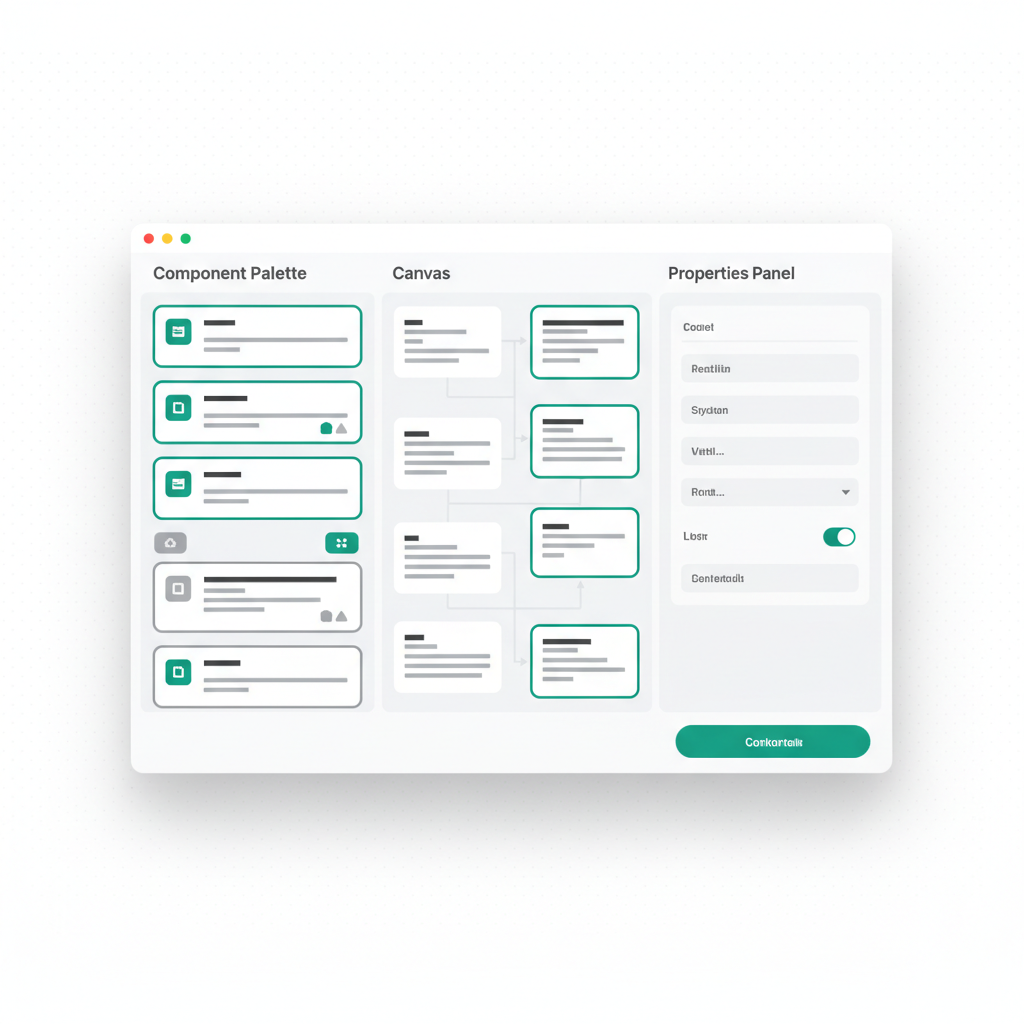
No-code platforms like Bubble, Webflow, and Adalo provide visual builders where you construct interfaces by dragging components onto a canvas and connecting them with logic flows. The platform generates the underlying code (or uses a proprietary runtime), but you never see or interact with it directly.
The strengths of no-code are real: visual builders are intuitive, the learning curve is gentle, and simple applications can be assembled quickly. For forms, surveys, basic data collection, and workflow automation, no-code platforms are genuinely effective.
The limitations are also real. Customization beyond what the platform supports is difficult or impossible. Performance can suffer because the generated runtime is optimized for generality, not for your specific use case. And most critically, you typically cannot export your project as standard source code. Your application lives on the platform, and moving to custom infrastructure means rebuilding from scratch.
How AI Code Generation Works
AI code generators take a different approach. Instead of providing a visual builder, they accept natural language descriptions and produce actual source code -- React components, TypeScript files, Tailwind CSS styles, database schemas, and API endpoints. The output is standard, readable code that you can run locally, deploy anywhere, and modify with traditional development tools.
This approach preserves full flexibility. Because the output is real code, there are no artificial limitations on what you can build. Any feature that React, Flutter, or Three.js supports can be generated. And because you own the source code, you can export it, extend it with manual development, and deploy it to any hosting provider.
Where Each Approach Excels
No-code platforms excel at simple, well-defined applications: landing pages, contact forms, basic databases, and internal workflow tools. If your application fits neatly within the platform's capabilities, no-code can be the fastest path to a working product.
AI code generation excels at more complex applications: multi-page dashboards, full-stack applications with custom backends, mobile apps with native performance, and any project that may eventually need custom development. The code output means there is no ceiling on complexity and no vendor lock-in.
The Convergence
The most interesting trend in 2026 is the convergence of these approaches. AI-powered platforms increasingly offer visual preview and editing alongside code generation. You describe what you want in natural language, see a live preview of the generated application, and refine it through conversational edits. The result is code you own, built through an interface that feels as intuitive as a no-code tool.
This convergence is important because it addresses the core limitation of each approach. No-code gains the flexibility of real code output. AI generation gains the visual feedback and accessibility of drag-and-drop builders.

Choosing the Right Approach
Consider these factors when deciding:
- Complexity: Simple workflows and forms favor no-code; multi-feature applications favor AI generation
- Customization: If you need pixel-perfect control or custom features, AI-generated code provides more flexibility
- Longevity: For long-term projects, owning the source code protects your investment
- Team skills: No-code requires no coding knowledge; AI generation benefits from being able to review and modify code
- Export needs: If you might need to move off the platform later, code-based output is essential
Conclusion
No-code and AI-powered development are not competing philosophies -- they are complementary tools in a broader movement toward making software creation more accessible. The best builders understand both approaches and choose the right one based on the specific requirements of each project.
The future likely belongs to platforms that combine the intuitive experience of no-code with the power and flexibility of AI-generated source code.
Published by João Castro · 6 min read