
backend12 min read

The 6 Best Full-Stack AI App Builders in 2026 (Real Backends Compared)

Which AI app builders generate a real backend — database, auth, APIs — and which are frontend tools with integrations? VULK, Lovable, Bolt, Replit, Databutton, Base44 compared. Pricing verified July 17, 2026.

The 6 Best Full-Stack AI App Builders in 2026 (Real Backends Compared)

Which AI app builders generate a real backend?

Short answer: only some of them, and the difference is the single most important thing to check before subscribing. VULK (our product — disclosure below) and Databutton generate and deploy real backends — databases, auth, server-side logic — as part of the app. Replit provisions genuine infrastructure its agent can program freely. Base44 includes a built-in backend you can't take with you. Lovable and Bolt are superb frontend generators that delegate the backend to Supabase. None of these approaches is wrong — but they fail differently when your app grows.

Disclosure: VULK is our product. Backend generation is our strongest differentiator, so this is the listicle where we look best — treat our verdicts accordingly, and note the places we say a competitor is the better choice (there are several). Pricing verified July 17, 2026.

Comparison table: what "full-stack" actually means per tool

Tool Backend Database Auth Backend export Starting price
VULK Generated + deployed (API engine) PostgreSQL per project Generated (JWT, roles) Schema + data export (SQL/CSV); frontend ZIP + GitHub $3.99 3-day intro → $19.99/mo (paid-only)
Lovable Via Supabase Supabase Postgres Supabase Auth Your Supabase — yours to keep Free (limited) → $25/mo
Bolt Via Supabase Supabase Postgres Supabase Auth Your Supabase — yours to keep Free → $25/mo
Replit Agent-written, any language Hosted PostgreSQL Replit Auth or custom Full code access Free → Core $25/mo
Databutton Generated FastAPI (Python) Built-in + external Built-in Code visible/exportable $20/mo
Base44 Built-in (proprietary) Built-in Built-in No backend export Free (25 credits) → $20/mo

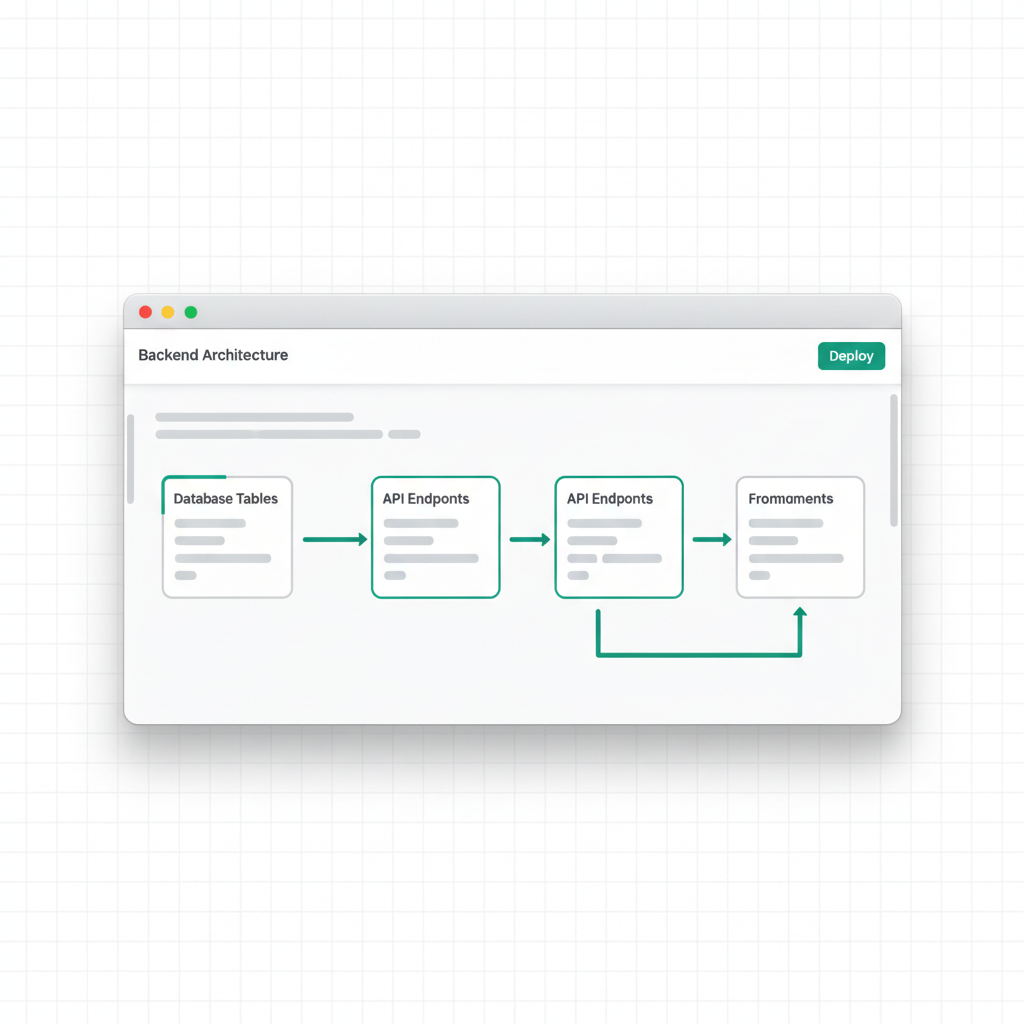
Three architectures hide behind the phrase "full-stack AI builder":

  1. Generated backend (VULK, Databutton): the AI writes your schema, endpoints, and auth as part of the app. Most flexible; quality depends on the generator.
  2. Delegated backend (Lovable, Bolt → Supabase): the tool wires your frontend to a managed BaaS. Excellent DX; you now operate two platforms, and the tool can only do what the BaaS exposes.
  3. Embedded backend (Base44, and Bubble in the no-code world): batteries included, zero setup — and zero portability.

What breaks first with frontend-first tools?

The wall every "AI app builder" user eventually hits: v0 and Bolt produce beautiful frontends fast, but real products need persistent data, user accounts, roles, server-side validation, scheduled jobs, and payments webhooks. With delegated backends you hand-assemble that in Supabase dashboards and edge functions. That's fine for developers who know Supabase; it's a cliff for everyone else. Generated-backend tools flatten that cliff — at the cost of you trusting generated server code (review it; with VULK the schema and endpoints are inspectable, and the editor includes a query runner and API tester against the live database).

Tool-by-tool: pros, cons, verdicts

1. VULK — best generated backend with data you can take

What it is: Prompt-to-app builder where "app" includes the server. A generated project ships a React + Vite frontend and a deployed backend: PostgreSQL schema, REST endpoints, JWT auth with role-based access, server-side logic. Live preview runs in Firecracker microVMs with hot reload; PHP/Laravel and Python (FastAPI/Flask/Django) backends also generate and preview (Python preview added July 2026).

Pros:

  • Real PostgreSQL per project, deployed with the app from the Builder tier up
  • Backend panel in the editor: browse tables, run raw SQL, test endpoints, export any table to CSV
  • Full frontend source export (ZIP + GitHub); schema.sql included in exports
  • Multi-platform on one subscription: web, Flutter (compiled APK/AAB), PHP, Python, 3D
  • 16 AI models + bring-your-own-model (Pro+)

Cons:

  • Paid-only — $3.99 3-day intro, then Builder $19.99/mo, Pro $39.99/mo, Max $199/mo; backend deploys start at Builder
  • Self-hosting a full-stack export requires rebuilding the backend runtime: exported frontends call VULK's hosted API engine, and the auto-CRUD/auth engine itself isn't in the ZIP (your schema and data are exportable; the engine is not)
  • No visual click-to-edit; no Vue/Svelte
  • Next.js SSR support is limited (thin Next projects work; deep SSR doesn't)

Verdict: The strongest option when the backend is the app — SaaS, marketplaces, anything with accounts and roles. Full portability caveat above is real; weigh it against Base44-style total lock-in.

2. Lovable — best delegated-backend experience

Pros: Deepest Supabase integration in the market — schema, auth flows, RLS policies, and realtime generated as part of the app; the Supabase project is yours, which is genuine portability; visual click-to-edit; Agent Mode.

Cons: Backend ceiling = Supabase's shape (Postgres + edge functions); no mobile, no other backend choices; you'll manage two dashboards and two bills as you scale; single AI model.

Pricing: Free (limited), then from $25/mo. Supabase billed separately beyond its free tier.

Verdict: If "full-stack" for you means React + Supabase — a great stack — Lovable executes it better than anyone, and the your-own-Supabase model is a portability advantage over generated-and-hosted backends.

3. Bolt — best for full-stack prototyping speed

Pros: WebContainers run actual Node.js in your browser — server code executes live while you prototype; Supabase integration for persistence; ZIP export; fastest iteration loop here.

Cons: The in-browser runtime is a dev environment, not production hosting — production data still means Supabase; Safari/mobile browser reliability issues; backend depth same ceiling as Lovable.

Pricing: Free tier, then from $25/mo.

Verdict: Best place to prototype a full-stack idea this afternoon. Plan the production backend story separately.

4. Replit — best when you need arbitrary backend logic

Pros: Real VMs, real shells, any language — the agent can write a FastAPI service, a Go worker, and a cron job in one project; hosted PostgreSQL; deployments with autoscaling; nothing is off-limits because nothing is templated.

Cons: General-purpose generation means more babysitting than framework-optimized tools; effort-based/usage pricing can surprise you; the IDE is a lot for non-developers.

Pricing: Free tier, then Core $25/mo + usage.

Verdict: When your backend has unusual requirements — background workers, websockets, third-party protocol integrations — Replit is the only tool here that won't fight you.

5. Databutton — best Python-native generated backend

Pros: Generates React frontends with FastAPI Python backends — a real, inspectable server stack; agent plans tasks and writes both sides; good fit for data-heavy and API-integration apps; Python ecosystem access.

Cons: Smaller company and community than the rest of this list; $20/mo entry with credit-based generation; deployment tied to its platform; less polished frontend output than v0/Lovable.

Pricing: From $20/mo.

Verdict: The closest philosophical neighbor to VULK on this list — generated real backends — with a Python flavor. Worth a serious look if your team thinks in Python.

6. Base44 — best zero-setup backend for non-technical builders

Pros: Auth, database, hosting, email — all built-in, zero configuration; the fastest "it just works" experience for non-developers; usable free tier (25 credits/mo).

Cons: The backend never leaves — no export, no self-host, apps run only on Base44; Wix acquired it for $80M in June 2025, with post-acquisition reviews reporting slower support and 15–30% price increases on some plans; credit-based pricing can loop while the AI fixes its own errors; GitHub export (frontend) is beta and paid.

Pricing: Free (25 credits/mo), then from $20/mo.

Verdict: For internal tools and MVPs by non-technical founders, the zero-setup pitch is real. Just go in knowing the exit doors are locked.

FAQ

What counts as a "real backend" in an AI app builder?

Four tests: (1) persistent relational data survives redeploys; (2) server-side auth with roles — not just client-side checks; (3) API endpoints that enforce validation server-side; (4) you can inspect and query the database directly. VULK, Replit, Databutton, and the Supabase-delegated tools pass all four; tools that store data in browser localStorage or mock APIs pass none.

Can I export my database and leave?

VULK: yes — per-table CSV export, raw SQL access, and schema.sql in source exports (the hosted CRUD/auth engine itself isn't exportable). Lovable/Bolt: your Supabase project is yours, full pg_dump access — the cleanest data portability model here. Replit: full access, it's your VM. Base44: no meaningful backend export. Always test the export path before you have 10,000 users, not after.

Are generated backends secure enough for production?

Treat them like code from a fast junior developer: broadly correct patterns (parameterized queries, hashed passwords, JWT), but review before launch — especially authorization rules (who can read whose rows) and input validation. Delegated backends inherit Supabase's mature RLS model but only if the generated policies are right; misconfigured RLS is the most common Supabase security failure.

Which tool is best for a SaaS MVP with user accounts and billing?

VULK or Lovable. VULK generates accounts, roles, and PostgreSQL in one shot and adds mobile/3D if your roadmap needs them. Lovable + Supabase + Stripe is a battle-tested combination with more community recipes. Frontend-first tools (v0) will leave you assembling the hard 60% yourself.

What about v0 — isn't it full-stack now?

v0 generates Next.js apps with server components and API routes and can attach services via the Vercel Marketplace, so it's no longer purely frontend. But its backend story is young and integration-shaped; UI generation remains its superpower. For backend-heavy apps, the six tools above are stronger today.

Is Bubble a full-stack AI builder?

Bubble is a full-stack no-code platform (visual workflows + built-in database, from $29/mo) with AI assists, not AI generation. It expresses complex apps well, but with zero code export — deeper lock-in than anything in this list except Base44.

How current is this pricing?

Verified July 17, 2026 on vendor pricing pages. Credit-based tools (Base44, Databutton) can cost well above the sticker price under heavy generation — budget for that.

Published by João Castro · 12 min read

VULK Support

Online

Hi! How can I help you today?

Popular topics

AI support • support.vulk.dev