Verified on October 10, 2026, against the code VULK runs today and its production records.
"3D website" can mean anything from a spinning logo to a game. This post says exactly what VULK does when you ask for one, which libraries end up in your project, how a 3D model gets made, how long it takes and what it costs in credits.
There are two different things under the word "3D" in VULK, and they are paid for differently:
- 3D scenes in code. The site itself draws in 3D: a product that turns as you scroll, a hero that follows your pointer, a full-screen scene.
- 3D models made for you. A real model file (GLB) of an object you describe or photograph, generated and then placed in the scene.
The libraries in your project
When a project needs 3D, the generator adds three runtime packages, at versions pinned in one place so the preview and the exported code match:
| Package | Version |
|---|---|
| three | 0.185.1 |
| @react-three/fiber | 9.6.1 |
| @react-three/drei | 10.7.7 |
| @types/three | 0.185.0 |
Projects without 3D do not get these packages at all. A landing page that does not draw in 3D does not pay the download cost of a 3D engine.
The site around the scene is the same React and Vite project VULK builds for any website, with GSAP for motion. When the 3D view is the whole product, as with a game or a simulator, VULK switches to a full-screen "stage" layout where the scene takes the entire viewport. In that layout only one file in the project may import Three.js, React Three Fiber or Drei, which keeps the 3D code in one place you can find and edit.
How a 3D model gets made
This is the part most "text to 3D" claims skip, so here is the real path.
The model is made from an image. VULK sends the image to Tencent's Hunyuan 3D Pro 3.1 and receives a GLB file with materials. If you describe the object in words, VULK first creates a reference photo with its default image model (Gemini 3.1 Flash Image) and then builds the mesh from that photo. If you attach your own photo, that photo is the source instead. In other words, "text to 3D" in VULK is text to photo to model, and you can see the photo the model came from.
You can choose the finish and the pose of an object when you ask for it. When you ask to change an object later, VULK makes a new object from the photo its parent was built from, so the original is not lost.
Then the file is prepared for the web. Every model goes through the same finishing step, using @gltf-transform/cli 4.5.0:
- Textures are re-encoded as lossless WebP, so normal and roughness maps do not pick up compression artefacts.
- Geometry is compressed with Draco, quantising positions at 16 bits, normals at 12 and texture coordinates at 14.
- Texture size is kept as delivered, and triangles are not reduced. Simplification, even at a tiny error setting, visibly creased smooth painted panels, so the finishing step keeps the source geometry.
Then it is checked. The file must be a valid GLB that actually contains geometry. After that, a planning model (GPT-6.1 Sol) writes what to inspect, a separate vision model (Gemini 3.7 Flash) looks at the images, and a fixed rule in code makes the final call. A job gets at most three paid attempts; it never quietly tries a fourth time.
How long it takes, measured
From production records, read on October 10, 2026: between September 11 and October 8, 2026, the median finished model job took 485 seconds, about eight minutes, from the moment it was created to its last update.
Once a model is finished, you can also download it as a GLB file from its line in the project card and use it elsewhere.
What it costs
- Builder does not include 3D, neither scenes in code nor generated models. The plan card shows the row as not included.
- Pro, Max, Team, Business and Enterprise include both.
- One generated 3D model costs 30 VULK credits. How many objects a project can hold depends on your credit balance, not on a fixed limit of three or four per site.
Plan prices are on the pricing page: Builder is $19.99 a month, Pro $39.99 and Max $199, read on October 10, 2026.
What happens on a device that cannot draw 3D
Not every visitor has WebGL. When it is missing, the scene shows a designed fallback, a wash in the site's own colours, instead of a blank rectangle. Scenes respect the visitor's reduced-motion setting, and they render at a lower pixel density on screens narrower than 768 pixels.
You can also take 3D out of a project you already have. Asking VULK to remove it removes the 3D runtime and adapts the pages that used it, instead of leaving broken imports behind.
Games: what exists
People ask VULK for games often, so it is worth separating what the product does from what is in the showcase.
In the product: a game is a 3D project in stage mode. Small games can also run directly inside the chat as a self-contained HTML piece, limited to 64 KB and shown in a sandboxed frame that cannot reach the page around it.
In the showcase: Rutura is an adventure game our team built and published as a showcase original. Its two characters are real skinned models served from the site: the ranger file is 10,237,204 bytes with 174,688 triangles and a 52-joint skeleton, and each character has three animation clips.
Public 3D projects you can open
These are showcase projects, built and published by our team. Open them on a laptop and on a phone to see how a scene behaves on both:
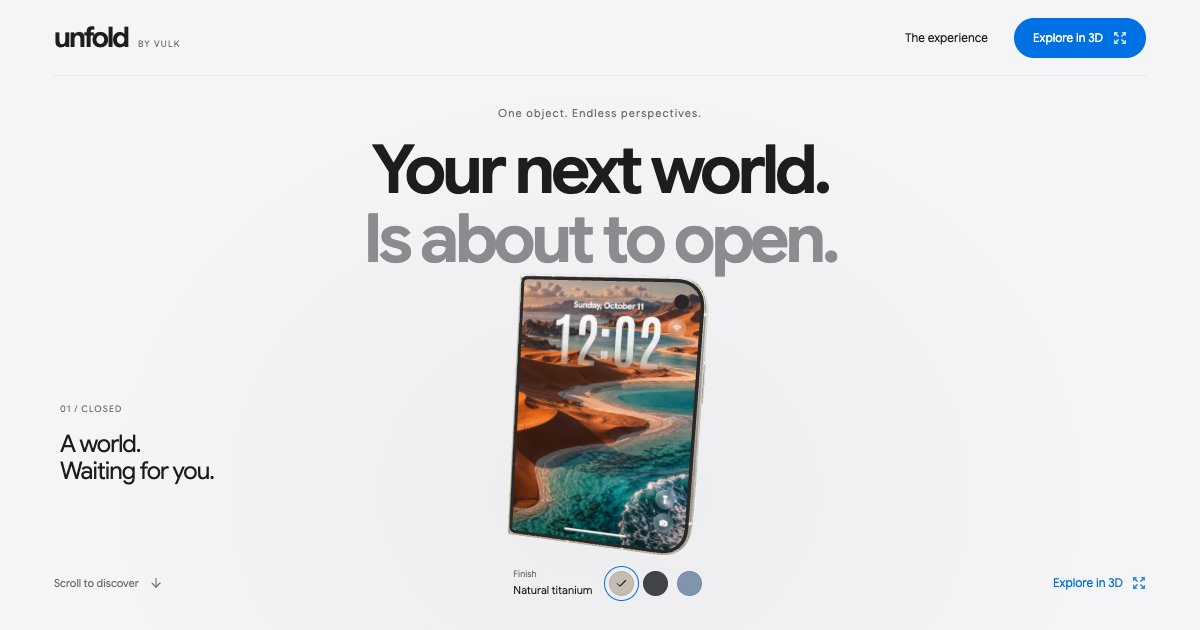
- Unfold, one object seen from every angle.
- Ossa, stone speakers in a React Three Fiber scene.
- Rutura, the adventure described above.
- Miso, a small cat in a kinetic world.
The full catalogue is in the showcase, filtered by category.
FAQ
Which 3D library does VULK use?
Three.js 0.185.1 with React Three Fiber 9.6.1 and Drei 10.7.7. They are added only to projects that draw in 3D.
Can VULK make a 3D model from a photo?
Yes. Attach the photo and VULK builds the model from it with Hunyuan 3D Pro 3.1. From a text description, VULK first creates a reference photo and builds from that.
How long does a model take?
The median finished job between September 11 and October 8, 2026 took 485 seconds, about eight minutes.
Which plan do I need for 3D?
Pro or higher. Builder does not include 3D scenes or generated models. Each generated model costs 30 credits.