Updated July 18, 2026 — rewritten to describe the verification gates as they actually run today, including the render gate.
How does VULK verify that a generated app actually works?
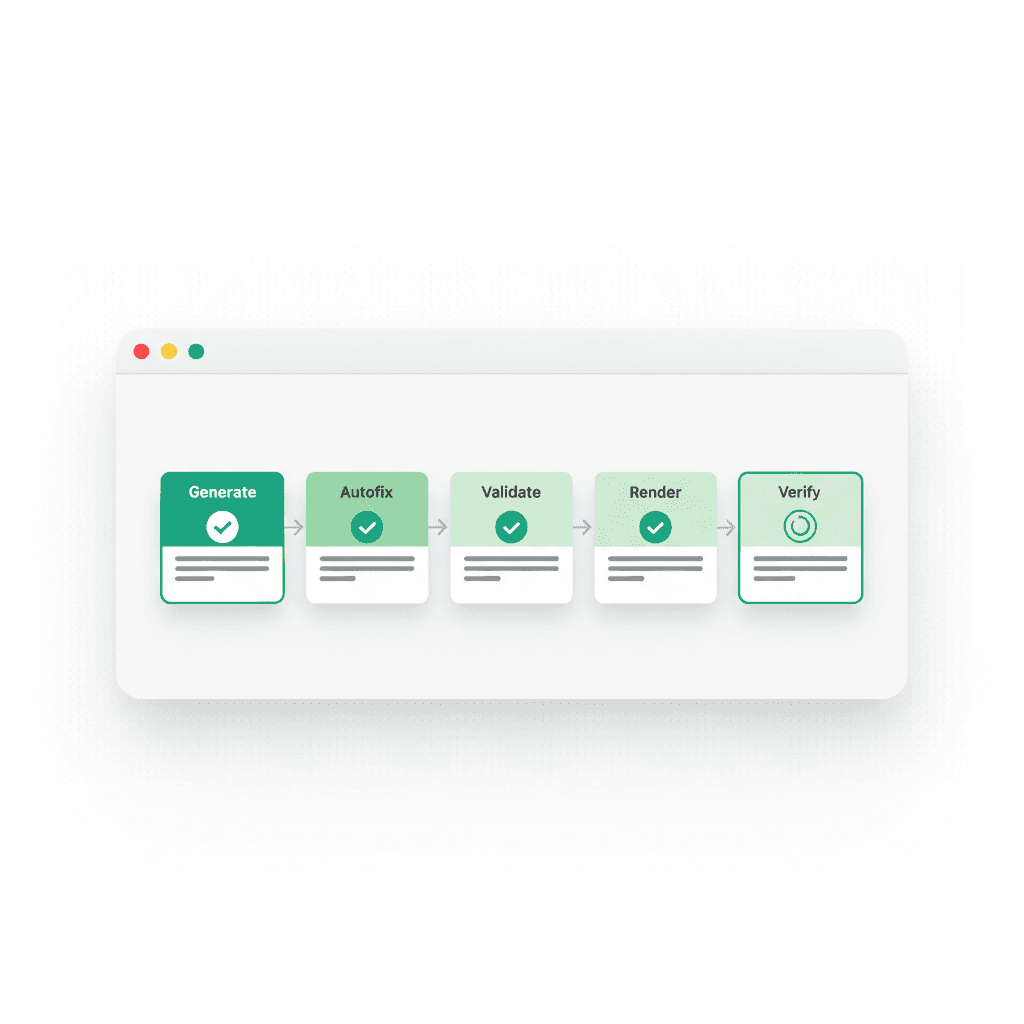
The complete answer: every VULK generation passes through a layered verification pipeline before you see it. Phase-gated generation structures the build so files are produced in dependency order and failures are caught early. A deterministic autofixer repairs mechanical errors (missing imports, missing dependencies, broken references) without extra AI calls. Vite validation runs a real build — TypeScript compilation, module resolution, CSS processing — on the server, and feeds any errors back to the model for a targeted fix rather than a regeneration. Finally, the render gate loads the already-running preview in a real Chromium browser and hard-fails the generation if the page is blank, an error boundary is visible, or a 3D brief produced no rendering canvas.
Why this pipeline exists: AI-generated code has a dirty secret — a meaningful share of it looks right and does not run. Valid syntax, plausible imports, white screen. "It compiles" is not the same claim as "it renders," and VULK is built to verify the second one. The scale makes automation non-negotiable: the platform has generated 124,755 code files across 11,355 projects, with a median of 20 files per app (VULK platform data, July 2026) — no human is eyeballing that output.
What are the verification stages?
Stage 1: Phase-Gated Generation
    ↓
Stage 2: Deterministic Autofixer
    ↓
Stage 3: Vite Validation (server-side build)
    ↓
Stage 4: Render Gate (real Chromium on the live preview)
    ↓
Stage 5: Fallback Recovery
| Stage | What it catches | How |
|---|---|---|
| Phase-gated generation | Wrong assumptions propagating across files | Files generated in dependency order, phase by phase |
| Autofixer | Missing imports, missing deps, broken references | Deterministic rules — no AI call, fast and repeatable |
| Vite validation | Type errors, unresolvable modules, CSS breakage | Real vite build on the server; errors → targeted AI fix |
| Render gate | White screens, error boundaries, blank canvases | Real Chromium loads the live preview and asserts on the DOM |
| Fallback recovery | Unrecoverable pipeline errors | Graceful fallback to the standard generation loop |
How does phase-gated generation work?
Instead of generating all files at once and hoping they work together, VULK generates in phases:
- Foundation — package.json, config files, entry point
- Data Layer — types, interfaces, API schemas
- Components — UI components in dependency order
- Pages — route pages that compose components
- Integration — connecting everything, final wiring
Each phase must complete successfully before the next begins. If a component fails to generate properly, it is caught immediately — not after 50 files have been written on top of the wrong assumption.
What does the autofixer repair?
When the pipeline detects a mechanical issue — missing imports, type mismatches, missing packages, circular dependencies — the autofixer attempts automatic repair:
- Missing imports: scans the project's file tree and resolves the correct import path
- Missing dependencies: adds required packages to package.json
- Type errors: infers the expected type from usage context and adds annotations
- Circular references: restructures imports to break dependency cycles
The autofixer operates without making a new AI call — it uses deterministic rules, making it fast, cheap, and repeatable. The same input always produces the same fix.
What does Vite validation check?
After files are generated and auto-fixed, VULK runs a real Vite build on the server: full TypeScript compilation, module resolution verification, CSS/Tailwind processing. This is the same strictness your production deploy will face — the dev server tolerates things the production build rejects, so validating with the real build catches that class of surprise early.
If Vite reports errors, they are fed back to the AI for a targeted fix — the model sees the exact error and the exact file, not a request to regenerate the app. This focused repair loop typically resolves issues in a single iteration.
What is the render gate, exactly?
This is the stage most AI builders skip, and it is the one that matters most: source checks can all pass while the app renders an error screen. A generation can compile cleanly and still die at runtime with something as small as an undefined variable — leaving a white page or a visible error boundary.
The render gate closes that hole. It loads the already-running preview URL — no rebuild, no artificial harness — in a real Chromium instance, and applies hard-fail assertions:
- The page renders actual content (no blank viewport above the fold)
- No visible error boundary or fallback error heading
- No fatal page errors in the console
- If the brief asked for 3D/WebGL: a
<canvas>exists and is not blank - A screenshot is captured as evidence
That last canvas check is characteristic of how VULK thinks about verification: for a 3D scene, "the page loaded" is not success — pixels rendered on the canvas is success. Games and 3D are the platform's #2 category at 5.4% of generations (VULK platform data, July 2026), so this check runs a lot.
When the render gate fails, the errors go back to the model for a fix cycle rather than being shipped to you as a broken app.
What happens when verification cannot recover?
If the pipeline hits an unrecoverable error at any stage, it does not crash or return nothing. It gracefully falls back to the standard generation loop, which produces functional output without the full verification treatment. You always get code; verification makes it trustworthy.
The same philosophy extends into iteration: the preview feeds console errors back into the conversation, so "run, read errors, fix" — the loop a human developer runs by hand — happens inside the platform in seconds.
How does this compare to other AI builders?
Most AI builders generate code and rely on you to spot and report what is broken. The honest comparison:
| Capability | VULK | Lovable | Bolt | v0 |
|---|---|---|---|---|
| Server-side build validation | Yes (real Vite build) | No | WebContainer (in-browser) | No |
| Deterministic autofix layer | Yes | No | Partial | No |
| Phase-gated generation | Yes | No | No | No |
| Real-browser render check | Yes (Chromium on live preview) | No | In-browser only | No |
| Blank-canvas detection for 3D | Yes | No | No | No |
| Graceful fallback pipeline | Yes | No | No | No |
FAQ
Does verification slow down my generation?
Slightly — the validation and render checks add seconds, not minutes, and they run while results stream. The trade is deliberate: a few extra seconds of checking versus you debugging a white screen. The median VULK builder still gets a first running app 47 seconds after signup (VULK platform data, July 2026).
What does the render gate actually assert?
Loaded in real Chromium against your live preview: content renders above the fold (no blank viewport), no visible error boundary, no fatal console/page errors, and — when the brief asked for 3D — a non-blank WebGL canvas. A screenshot is captured as evidence of the verdict.
Can verified generation still produce a broken app?
It can — no verification system is a guarantee, and VULK does not claim one. What the pipeline eliminates is the most common failure class: apps that look complete but render nothing. When something does slip through, the self-debugging loop (preview console errors fed back to the model) usually fixes it in one follow-up message.
Do I need to configure or enable any of this?
No. Verification is the default pipeline for every generation on every plan. There is no "verified mode" toggle — the unverified path exists only as an internal fallback when the pipeline itself hits an error.
Does verification cover all 8 platforms?
The deepest checks (Vite validation + render gate) cover the web-runnable stacks: React + Vite and Three.js. Flutter verifies through its real flutter build web compile — a build that fails loudly is its own gate. Platforms without live preview (React Native, Shopify) get generation-time structural validation, and their ecosystem tooling (Expo, Shopify CLI) is the runtime check.
Every VULK generation runs this pipeline by default. Build something complex — a multi-page dashboard with auth and data tables — at vulk.dev and notice how it just works on the first try. VULK is paid-only: plans from Builder $19.99/mo, 3-day intro from $3.99.